
The Clearwater F6C1-UF: Next-Generation Water Filtration Explained
Most people know their water filter is doing something useful, but the specifics of how tend to stay a mystery. The Clearwater F6C1-UF is built around a straightforward idea: water should be as clean as nature intended. For UK households, where chlorinated mains water and limescale are everyday concerns, it combines three distinct filtration stages in one cartridge to reduce a wide range of contaminants while keeping the beneficial minerals in your water intact.
The standout feature is the ultrafiltration membrane, which filters down to 0.01 microns. Clearwater position this as 3,000 times more powerful than a standard jug filter. That level of filtration is capable of reducing particulate matter, lead, cysts, iron, arsenic V and microplastics, as well as pathogens including viruses and bacteria. No electricity, no wasted water and no drain connection are required.
Let's explore how your Clearwater F6C1-UF filter cartridge works
Water enters at the top of the cartridge and passes through three distinct stages before reaching your tap. Each stage targets different contaminants, and together they cover a broad spectrum of what you typically find in UK mains water.
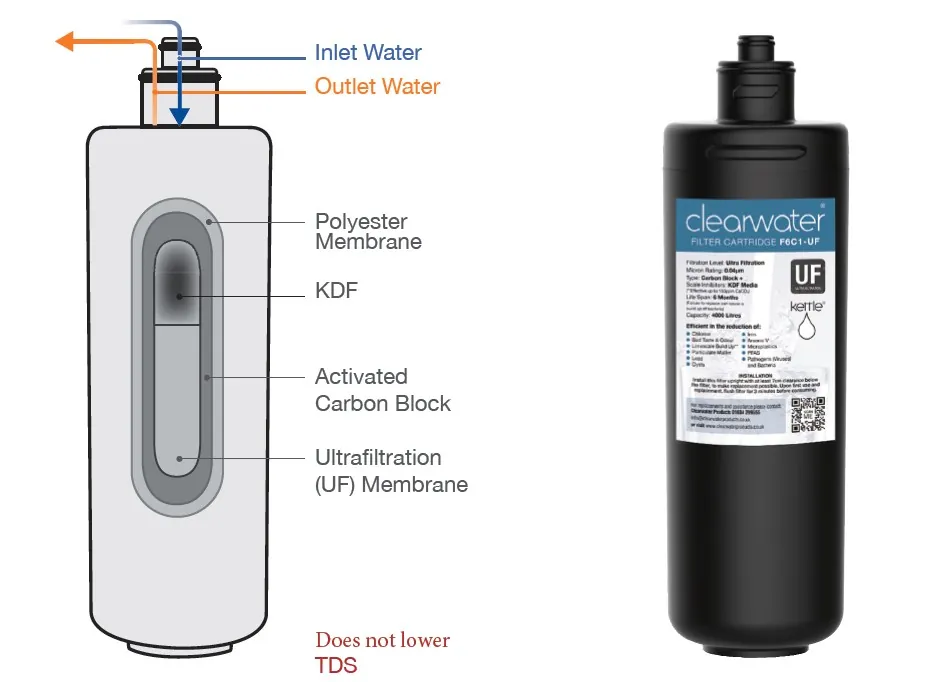
1. Activated Carbon Block:
The carbon block stage captures larger particles and conditions the water by absorbing chlorine, bad tastes and odours. Think of it like a sponge: water passes through while chlorine and other off-flavour compounds stick to the carbon surface. The result is clear, great-tasting water free of chemical smells. This stage also contributes to the reduction of PFAS, commonly referred to as forever chemicals. The carbon media used is coconut activated carbon.
2. KDF 55 Scale Inhibitor Media:
KDF 55 media works by disrupting the ability of calcium and other hard water minerals to crystallise and stick to surfaces, preventing limescale from building up in your appliances. Unlike resin softeners or reverse osmosis, it retains all of the beneficial minerals in the water so your supply keeps its nutritional value. It performs best in water supplies up to 180 ppm CaCO₃. Above that level, a traditional resin softener may be more appropriate for heavy use hot water equipment.
3. Ultrafiltration (UF) Membrane:
The ultrafiltration membrane has pore sizes of 0.01 to 0.04 microns. To put that into perspective, the average human hair is 70 microns and the naked eye can only resolve objects down to 50 microns. This superfine barrier efficiently reduces particulate matter, lead, cysts, iron, arsenic V and microplastics, which typically range between 0.1 and 5 microns, as well as pathogens including viruses and bacteria, which typically fall between 0.2 and 2.0 microns.
Good to know: Unlike reverse osmosis systems, the F6C1-UF does not lower TDS or strip out the natural mineral content of your water. The filter targets contaminants only, leaving beneficial minerals untouched.
What the F6C1-UF Is Effective at Reducing
Across its three filtration stages the cartridge is designed to reduce the following contaminants, many of which are common concerns for households in the UK on mains water.
Chlorine
Bad Taste & Odour
Lead
Iron
Arsenic V
Microplastics
PFASS (forever chemicals)
Particulate matter
Limescale Buildup
Bacteria & Viruses
Cysts
How Does This Compare to a Standard Jug Filter?
Clearwater describe the UltraPure filtration as 3,000 times more powerful than a standard jug filter, filtering down to 0.01 microns. A typical jug filter, which is what many UK households have relied on for years, uses activated carbon to improve taste and reduce chlorine, but it does not have the membrane filtration needed to reduce bacteria, viruses or microplastics. The ultrafiltration membrane in the F6C1-UF is what makes that level of reduction possible.
The filter also integrates neatly under the sink as part of the Clearwater KettlePure system. There is no countertop unit to manage and no cartridge to fill manually. The quarter-turn release mechanism means cartridge changes are quick and tool-free, with the water supply shutting off automatically during the swap.
Frequently Asked Questions
Will the F6C1-UF lower the TDS reading in my water?
No. The F6C1-UF is specifically designed not to lower TDS. Unlike reverse osmosis, ultrafiltration retains the healthy minerals naturally present in your water. The filter targets contaminants based on particle size and adsorption rather than stripping everything dissolved in the water.
My water is quite hard. Will this filter help with limescale?
The KDF 55 media in the cartridge is effective at disrupting limescale formation in water supplies up to 180 ppm CaCO₃. If your water hardness exceeds that level, Clearwater recommend a traditional resin softener for heavy use hot water equipment.
What head options are available for the F6C1-UF?
The filter is compatible with two head types: an auto shut off head and a manual isolation arm. The F-series head is moulded with bracket points for quick and easy installation, and single and double head configurations are available, allowing users to build systems tailored to their specific needs. Both head types use 1/4 inch and 3/8 inch push-fit ports.
Can I drink the water straight away after fitting a new cartridge?
Clearwater advise flushing the filter for 2 minutes after installation before consuming the water. This clears any residual particles from the new cartridge before first use.
Does this filter need electricity to work?
No. The F6C1-UF operates entirely on normal household mains water pressure. No electricity, no pump and no drain connection are required, making it straightforward to install and producing no wasted water in the filtration process.